The liquid-cooled power unit handles AC/DC conversion and distributes power via a DC bus to all connected dispensers. Up to 600 kW of system power is available, offering flexibility and scalability for any location.

RFID support in accordance with ISO/IEC 14443 A/B, ISO/IEC 15693, and NFC for various card and token systems
Integration with the Huawei FusionCharge Cloud for remote monitoring of charging performance
Compatible with OCPP backend systems for cross-vendor load management and the integration of payment solutions such as Bill.Bo
CE-certified in accordance with EU directives; CE marking documented


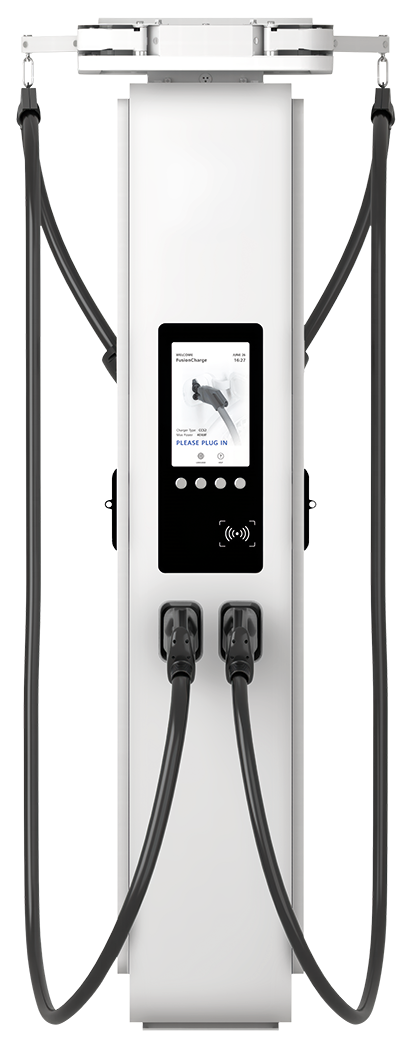
Dual-Gun Function: Two vehicles can charge simultaneously using a single charger
Up to 480 kW of total power at two CCS2 ports
500 A peak current per port for maximum charging speed
2×375 A continuous current for stable, continuous fast charging
IP55 protection rating for reliable outdoor use in all weather conditions
MID/LNE-certified energy meter for charging in compliance with metrology regulations
Flexible Authentication via RFID, QR Code
Compliant with IEC 61851, IEC 62196, DIN 70121, and ISO 15118
The liquid-cooled power unit handles AC/DC conversion and distributes power via a DC bus to all connected dispensers. Up to 600 kW of system power is available, offering flexibility and scalability for any location.
The FusionCharge system dynamically distributes the available power among all connected charging points. If a dispenser is not currently being used for charging, that capacity is immediately made available to the others. This ensures that no power goes to waste.
The Huawei Management system allows for centralized monitoring of all charging points, analysis of operational data, and early detection of faults. Connectivity is provided via 4G or Ethernet, and OCPP interfaces enable integration with existing backend systems.
Huawei FusionCharge adds smart charging infrastructure to the Huawei FusionSolar ecosystem. Power generation, storage, and charging stations can be monitored and managed through the respective Huawei cloud solutions. Cloud monitoring, along with load management and service support features, ensure efficient operation.

The DT500N2-EUA2 features two CCS2 ports, allowing two vehicles to be charged simultaneously at a single charging station. The DT500L1-EUA2 has only one port, but it features liquid-cooled cables for maximum continuous power at a single charging point.
No. The Boost Charging Dispenser must be connected to a Huawei Liquid-Cooled Power Unit (RPC), which handles AC/DC conversion and power supply. The dispenser itself provides the user interface and charging technology.
The dispenser uses the CCS2 (Combined Charging System) standard and communicates via ISO 15118-2 and DIN 70121. It is therefore compatible with the vast majority of electric vehicles available in Europe that support DC charging.
Yes. With an IP55 protection rating, the device is protected against dust and water jets. The operating temperature range of −30 °C to +55 °C allows for year-round outdoor use in nearly all climatic zones in Europe.
The DT500N2-EUA2 is equipped with a MID- and LNE-certified energy meter and is therefore compliant with metrology regulations. This ensures that the measured charging volumes meet legal requirements. For billing, select a suitable CPMS service provider to handle the management and billing of charging transactions.
During normal operation, 375 A of continuous current is available per connection. For short periods, peak currents of up to 500 A per connector are possible, allowing for a charging time of approximately 46 minutes at 25 °C. The actual power available depends on the connected power unit and the system configuration.
Yes, the DT500N2-EUA2 can be integrated into an existing energy management system (EMS) via OCPP-compatible interfaces. The EMS handles the central control, management, and billing of the charging infrastructure—and enables the targeted distribution of the generated energy.
The Huawei platforms FusionSolar and FusionCharge Cloud play a complementary role: They collect and monitor energy data such as the amount, timing, and history of energy feed-in. The actual control and management of the charging infrastructure is then handled by the software provided by the respective EMS vendor.

